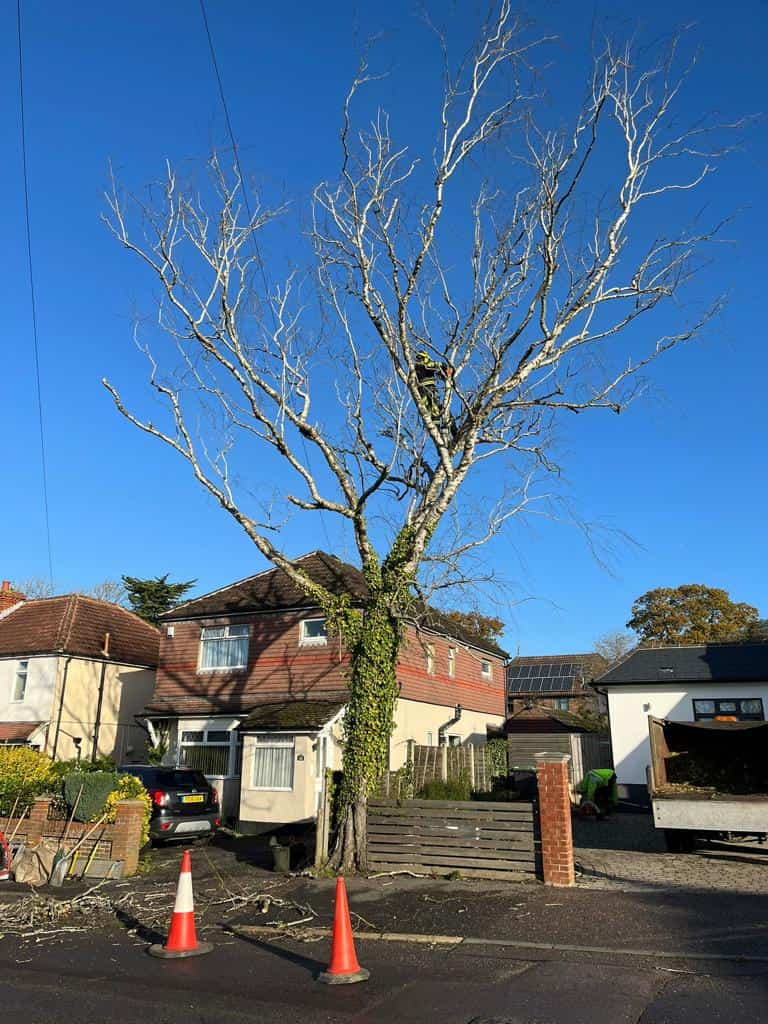
Large, established trees can be an important feature of a garden, providing character, greenery and a strong sense of maturity. However, as a tree’s crown develops, its size and spread can sometimes become difficult to accommodate comfortably within the surrounding outdoor space. Branches may extend further across the garden, the canopy can become increasingly dominant, and neighbouring garden features may begin to feel restricted.
Crown reduction is a professional tree surgery technique designed to reduce the overall dimensions of a tree’s canopy while retaining its natural form as far as reasonably possible. For homeowners in Brockworth, Gloucestershire, carefully planned crown reduction can sometimes make a large tree considerably easier to live with without unnecessarily removing it.
How Does Crown Reduction Make a Large Tree More Manageable?
Crown reduction involves selectively shortening branches throughout the outer canopy to reduce its height, spread or overall volume. It is not simply a matter of cutting every branch back by the same amount.
The work needs to consider the tree’s species, structure, condition and natural growth pattern. Suitable pruning points are selected so that the remaining crown retains an appropriate shape and branch framework.
When carried out correctly, crown reduction can help bring an oversized canopy into better proportion with the garden while preserving the presence and character of the tree.
Reducing Excessive Canopy Spread
One of the most common difficulties with mature trees is lateral spread.
As branches extend outwards, they can begin occupying a substantial proportion of the available garden. A tree that once fitted comfortably into its surroundings may eventually overhang lawns, planting areas, paths or other regularly used spaces.
Selective crown reduction can shorten excessive branch extension and create a more contained canopy.
The objective is not to make a large tree artificially small. Instead, the work aims to achieve a more suitable relationship between the tree and the space available around it.
Bringing an Overly Dominant Tree Back Into Proportion
A mature tree can sometimes become visually overwhelming within a garden.
The canopy may dominate views from the property or make surrounding landscaping appear secondary. In smaller or more structured gardens, this can affect the overall balance of the outdoor space.
Reducing the crown can help restore a more appropriate sense of proportion.
The tree remains an important landscape feature, but its canopy can sit more comfortably alongside lawns, planting, boundaries and other garden elements.
Improving Clearance Around Garden Features
Growing branches do not necessarily remain conveniently positioned.
Over time, they may extend towards sheds, paths, seating areas or other features. Lower or lateral branches can also reduce usable space beneath and around the tree.
Crown reduction can selectively address excessive extension where appropriate, creating improved separation between the canopy and surrounding garden features.
This should always be approached according to the structure of the tree rather than simply cutting branches wherever additional clearance is wanted.
Managing Branches Growing Towards the Property
A large tree positioned relatively close to a property may eventually develop branches that extend towards the building.
Even where branches are not physically touching, their increasing spread can make the tree feel too dominant around the house. Selective reduction may provide additional clearance while retaining a balanced canopy.
The important point is that pruning should consider the complete crown.
Removing substantial growth from only one side without considering overall balance can leave the tree with an undesirable shape and may result in an inappropriate distribution of remaining growth.
Crown Reduction Can Improve Light Around the Garden
A large canopy can influence how much sunlight reaches areas beneath and around it.
Reducing the extent of the crown may allow more light around certain sections of the garden, particularly where long branches have developed over open spaces.
However, crown reduction should not be confused with removing large quantities of internal growth simply to create maximum light.
The amount and position of pruning should be guided by the tree’s condition and structure. The aim is to manage the canopy appropriately while maintaining a healthy, recognisable tree form.
A Smaller Crown Can Feel Less Enclosed
The physical size of a tree can influence how spacious a garden feels.
Where a broad canopy extends across much of the available area, the garden may feel more enclosed than its actual dimensions suggest. Reducing excessive height or spread can sometimes create a greater sense of openness.
This can be particularly useful where the tree has gradually outgrown the proportions of the surrounding landscape.
Rather than removing an established tree solely because it feels too large, professional assessment can determine whether suitable crown management could achieve a better balance.
Crown Reduction Is Different From Topping
Proper crown reduction should not be confused with indiscriminately cutting off the top or ends of major branches.
Harsh cutting can remove the natural branch structure and leave numerous inappropriate pruning points. It can also significantly alter the appearance of the tree.
Professional crown reduction takes a selective approach. Individual branches are shortened back to appropriate growth points throughout the canopy, with consideration given to the shape and structure that remain.
This difference is fundamental to achieving a tree that looks deliberately managed rather than severely cut back.
The Natural Shape of the Tree Still Matters
Every tree has its own characteristic growth habit.
Some naturally develop broad crowns, while others have a more upright form. Crown reduction should work with these characteristics rather than trying to force every tree into the same shape.
The finished crown should generally remain recognisable as belonging to that particular tree.
This requires judgement when deciding which branches to shorten, how much material to remove and how the different parts of the canopy should relate to one another after pruning.
Not Every Branch Should Be Reduced Equally
A uniform reduction measured identically across every branch is not always the most appropriate approach.
Different sections of the canopy may have developed at different rates. One side may extend considerably further than another, while particular branches may require more attention because of their position or form.
Professional tree surgery allows the work to respond to these differences.
Selective pruning can therefore create a more balanced result than treating the crown as though it were a hedge requiring a uniform cut.
Tree Condition Should Be Assessed Before Reduction
Before crown reduction is undertaken, the condition of the tree should be considered.
Branches may contain deadwood, defects or areas of poor growth that influence how the work should be approached. The overall structure of the crown also helps determine whether reduction is appropriate and what level of pruning the tree can reasonably accommodate.
A professional assessment provides the opportunity to identify these factors before work begins.
This ensures that the proposed reduction reflects the actual tree rather than being based solely on the desired finished size.
Crown Reduction Can Help Retain Mature Trees
When a tree becomes difficult to accommodate, removal can sometimes seem like the most straightforward option. However, size alone does not necessarily mean that a mature tree needs to be removed.
Where the tree is otherwise suitable for retention, crown reduction can sometimes address the aspects causing difficulty while preserving the tree as an established garden feature.
This can be particularly valuable where the tree contributes significantly to the appearance and structure of the outdoor space.
The decision should be based on professional assessment of the individual tree and its surroundings.
How Much Should a Tree Crown Be Reduced?
There is no single percentage or measurement suitable for every tree.
The appropriate reduction depends on species, maturity, condition, existing structure and the reason the work is required. The available growing space and relationship with nearby features should also be considered.
Excessive reduction can unnecessarily alter the crown and remove more growth than required.
A carefully specified reduction focuses on achieving the necessary improvement while retaining an appropriate amount of healthy canopy.
Future Growth Should Be Considered
Crown reduction does not permanently stop a tree from growing.
Trees continue developing after pruning, although the rate and pattern of subsequent growth will vary. This means the work should consider not only the immediate appearance but also how the canopy is likely to respond afterwards.
Good tree management takes a longer-term view.
Rather than waiting until a tree has become severely oversized before undertaking substantial work, appropriate management at suitable intervals can sometimes help maintain a more practical relationship between the tree and garden.
Professional Pruning Helps Avoid Unnecessary Work
It can be difficult to judge from ground level which branches need reducing and how the complete crown will respond.
Removing too much growth can unnecessarily change the tree, while reducing too little in the wrong areas may fail to address the reason the work was requested.
Professional tree surgery involves assessing the canopy as a complete structure before selecting appropriate pruning points.
This allows the work to be focused where it provides a meaningful improvement rather than simply removing branches because they are accessible.
Crown Reduction Should Have a Clear Purpose
Tree pruning is most effective when there is a defined objective.
For one garden, the priority may be reducing excessive lateral spread. For another, it may be improving clearance or bringing an oversized crown into better proportion with the available space.
Establishing the objective before pruning helps determine what work is actually necessary.
It also avoids unnecessary cutting and allows the finished result to be assessed against a practical purpose rather than simply whether the tree looks smaller.
Professional Crown Reduction in Brockworth, Gloucestershire
At EM Tree Surgery Brockworth, we assess the individual tree, its crown structure and its relationship with the surrounding garden before determining an appropriate approach to crown reduction.
Carefully selected pruning can reduce excessive canopy dimensions while maintaining a balanced and natural appearance. The objective is to make the tree more manageable within its setting without removing more growth than necessary.
For homeowners in Brockworth, professional crown management can provide a practical way to retain a valued mature tree while improving how comfortably it fits within the garden.
Conclusion
Crown reduction can make a large tree easier to live with by reducing excessive height or spread, improving clearance and bringing an oversized canopy into better proportion with the surrounding garden.
The quality of the result depends on how the work is planned. Crown reduction should respond to the tree’s species, condition, structure and natural form rather than simply cutting branches back uniformly.
If a large tree is beginning to dominate your garden in Brockworth, Gloucestershire, contact EM Tree Surgery Brockworth to arrange a professional assessment. We can examine the tree and determine whether carefully planned crown reduction would provide an appropriate way to manage its size while retaining its character.
Call us on: 01452 941 558
Click here to find out more about EM Tree Surgery Brockworth
Click here to complete our contact form and see how we can help with your tree needs.